Friday, July 13, 2018

Week 32 - Key change in my professional practice

Key change in my professional practice


Using Rolf's Model of Reflection


A lot has happened over the past 32 weeks and equally a lot has happened over the past 6 terms. Being part of a new school is huge and combining that with postgraduate study has at times pushed me to my limits! (thank you for assessment extensions!)

However this course has definitely supported me, and the staff at my school, through our teaching and learning journey and has given me many tools to go back to - whether or not I have used them yet.

Step 1 (What): Identify one key change in your professional practice

Throughout this process I have focussed on a couple of things, however the one area that has always been driving my thinking is the commitment to families and whanau aspect and the professional relationships we are growing in our school.


As a school this is an important focus, as we set up relationships, community and the culture of our new school. Whilst this has always been important to me, our school has a big push for this and we are responding to our new community and the fact they live very busy lives that make it difficult to have them participate in traditional school practices, e.g. parent help.

This course has helped me to look at different ways to involve our whanau, help them to understand what it is that we do, and help them to be active participants in their child's learning.

Step 2 (Now what): Evaluate the identified change

Problem Identification: 
In the beginning we had the opportunity to interact a lot with our community - before we opened as a school. Since we opened, our community has grown rapidly and keeping up that same level of communication has become difficult. Not all of our families are as certain about how things are run as our foundation parents are and that is something that concerns us as a school as we want to be a whole community working towards the same goals.

Observation and analysis / Abstract re conceptualization
Before we opened we carried out many community consultation events, surveyed our future community and gathered that information to help inform the establishment of our school curriculum.

In our first year of operation we were more focussed on the day to day operation and dealing with the learners we had in front of us. 
Through observations and feedback from our community it became apparent by the end of the year that we needed to step up our community education and involvement.

Feedback from our newer parents is that they don't understand our play-based philosophy, that school is so different to their time. However our foundation parents are comfortable, understand the processes and can see the learning their children are doing. 
So our job as professionals is not to be reactive to the ones that don't yet understand and change what we are doing, but more to work out how we can help them to understand and feel comfortable.
We need to be responsive to their needs but remember that we have a lot of research, time and professional understanding behind us.

We have to be creative in how we help them to understand how our school works and what our vision is.  How can we help them to understand when they don't have the time to come into school and see it for themselves?

Active experimentation
Through this course, I had the opportunity to actively try out some different tools to help us and our students share their learning with their parents. We decided, after researching and discussing with other schools, that getting the children involved in making their learning visible was the best first step. We already had Linc-Ed as our student management system so we started using the student account aspect. Through this we found that our seniors could use this tool easily but that our middle / juniors struggled. So after discussion with fellow MindLab participants, I also began a very successful Seesaw trial. Having this as the gateway for our parents has opened up conversations. We had a far greater turnout to our Ako-conferences (learner led conferences) than we did to our parent information evenings - having the children leading it / being involved made their parents more involved.

Step 3 (What next) Share your next plan(s) regarding your future professional development or your future practice.
We are continuing with the Seesaw trial - there is still more professional learning to be done with this -  and will roll it out to the remainder of the Year 0-4 cohort in the next term. 
We are continuing conversations around how to further educate our parents  e.g. live-streaming or videoing school events / information evenings for those that can't attend.
We are also developing our own philosophy around how to use play-based learning through out the school - once we have a clearer picture and understanding then our community will also.

So much to do, but plenty of time to do it!


Week 31 Indigenous knowledge and cultural responsiveness in my practice

Indigenous knowledge and cultural responsiveness in my practice
Using Rolfe's Model of Reflection


Where are we currently?
I was lucky enough to attend ULearn in 2017 and hear Dr Ann Milne speak. You can read our staff shared notes from her ULearn Keynote here.


Image from Ka Hikitia


As a new school, we have been actively thinking about our cultural responsiveness and it is a focus across our staff and our Board of Trustees - as the BOT staff rep I am positioned to see both sides.

Our BOT uses Hautū to guide us, our teacher appraisal criteria (PTC) are integrated with the criteria from Tātaiako, our management team regularly refers to Ka Hikitia and the 5 principles to guide our school planning and set up.
 Image from Hautū 


We are developing a good relationship with our local rūnanga, Te Taumutu. They gifted us our school name - Te Uru Tarata (Lemonwood Grove) and they have developed a cultural narrative for educational institutions in our area (Rolleston).
Image from our cultural narrative


As a new school we are sometimes overwhelmed with the volume of things that we need to establish and embed, however we are also privileged to be in a position to create and embed our school culture from the beginning. The ideas behind cultural responsiveness support us with establishing our culture for ALL our learners. So as far as the policies, decision-making and planning, I believe we are heading along the right path.

So where to now?
We have the documentation as our foundation but what does this look like in practise / on the coalface? Where are we, a very European staff, positioned currently?


Using Dr Milne's action continuum, I feel that currently we are positioned towards the green. We still have a lot we can do but we also have to acknowledge all that we have done - this only being our second year!

Our Learning Landscape names and whakataukī 

Something that has been made apparent to me recently through getting to know my new team of learners (growing school, change happens!) is that many of our students don't know what their culture is and many of their whanau are also disconnected from their cultures. What does CULTURE mean and what is our responsibility as educators with regards to culture and cultural responsiveness?

Our next step is to look at how to include all of our community and their cultures in an authentic way throughout the year. How do we make all of our learners feel connected to us as a school and to their own cultures?  Taking what we have been doing in school to our community and involving them in the conversation - what are their views around cultural responsiveness?

Question we have recently been discussing are: Are our learners connected to their own cultures? Are our families? Do they want to be? How can we support them with this? Are we as a school forcing our students to explore a culture they have no connection with? (that last one I don't believe we are but it opens up a viewpoint for discussion). 

Currently I have more questions than answers but the conversation has started at our school and now we need to open that conversation to our community. 

References
CORE Education.(2017, 17 October). Dr Ann Milne, Colouring in the white spaces: Reclaiming cultural identity in whitestream schools.[video file]. Retrieved from https://www.youtube.com/watch?v=5cTvi5qxqp4&feature=em-subs_digest


Education Council,  Tātaiako - Cultural Competencies for Teachers of Māori Learners: A resource for use with the Graduating Teacher Standards and Practising Teacher Criteria 

Ministry of Education, (2013). Ka Hikitia - Accelerating Success 2013 - 2017. Wellington:
Ministry of Education.


Monday, July 9, 2018

Week 30 - Evaluating Trends - Digital Technology


This week we have been asked to critique and evaluate practice in the context of different audiences (local, national and/or international) and their perspectives.

One question that went through my mind whilst reading this weeks class notes was
How much is the change in education effecting our society and citizens? Are the changes we are implementing also responsible for some of the changes occurring in our society? Is it a case of education REACTING to change or are we being RESPONSIVE, anticipating and being proactive? As educators we have a responsibility to stay on top of the developing trends but also to be able to look ahead with a critical eye.
We don't have a crystal ball to the future, yet we are making changes to our practise as if we do. Is this therefore going to shape the future? What came first - the chicken or the egg?
I have no answers but this is where my mind went!

Back on topic:
The trend that caught my attention the most is the impact of digital learning. In Addressing Current and Future Challenges in Education, Daggett, B. (2014) argued that our students are digital natives but that they don't use their devices in school - that school has not kept pace with the trend towards using digital technology. 

I have often had issues with the term 'digital natives'. Yes, our students have grown up in a world where technology is the norm and where they use it every day but the term 'digital natives' implies that they are more adaptable to technology and it's use. I would argue that my generation and that of my parents have been through more changes in technology and are therefore better positioned to cope with changes in technology.  There are good definitions and debates of what the term 'digital natives' means HERE and HERE.
https://commons.wikimedia.org/wiki/File:Mobile_Phone_Evolution_1992_-_2014.jpg
Yes our students are quick to use new technologies and figure out how, at a basic level they work, but I have found they don't think much beyond the interface they are using - what we need to do is take them to that next level - how does this technology work? Pull it apart - look at the components; find out the coding that makes the game / app you are using work; what can they create with that device - instead of just being a consumer how can they purposefully use their technology to improve our society and their lives?

How do we take our students to that next level with their use of technology? To see that social media can be an awesome learning tool to connect and collaborate with, as Daggett, B. (2014), states they are doing?
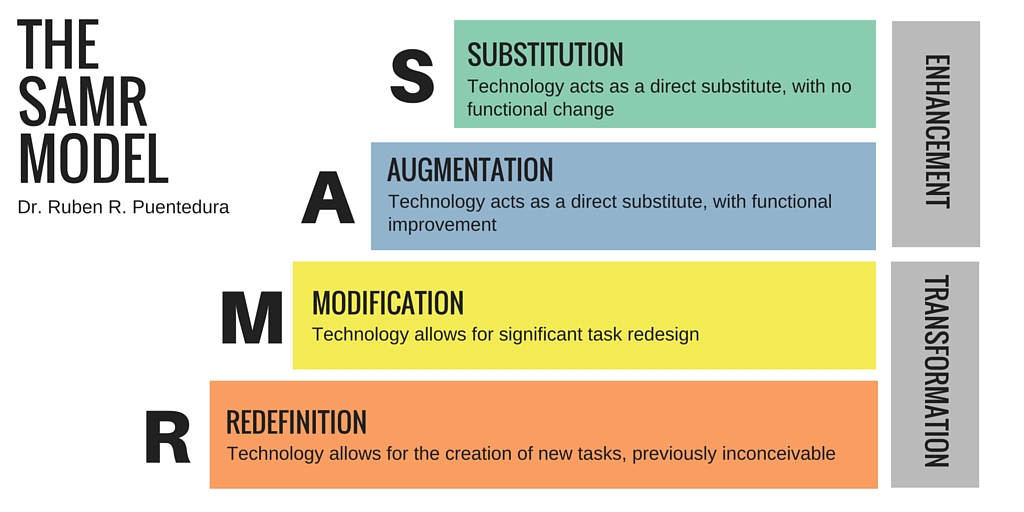
Just using, consuming the technology will not help our students in the future - encouraging them to create new technologies by understanding the current ones deeply, seeing if the technology can do what they want it to and then developing their own if it can't is where we should be encouraging our learners to go. How do we lead our students down the path of the SAMR model - using technology purposefully - getting to that redefinition level.

https://commons.wikimedia.org/wiki/File:The_SAMR_Model.jpg

The New Zealand Technology Curriculum (2017) has recently undergone an update that, I believe, begins to address this trend / issue.
The expectation of the curriculum is that "By the end of year 10, students’ digital technological knowledge and skills enable them to follow a predetermined process to design, develop, store, test and evaluate digital content to address a given issue."
This curriculum document is a great step towards helping our students become true digital natives. The limitations come from the confidence of their teachers to support them in their learning. Can we as educators be willing to learn alongside our students? Are we confident enough to try things out ourselves and to support our learners to explore and try? And will we have had the time to explore and unpack the new curriculum in our busy teaching lives? What are our priorities as educators and as a school and community?

References

Daggett, B. (2014). Addressing Current and Future Challenges in Education. Retrieved from http://www.leadered.com/pdf/2014 MSC_AddressingCurrentandFutureChallenges.pdf

https://www.techopedia.com/definition/28094/digital-native

https://www.investopedia.com/terms/d/digital-native.asp

http://www.schrockguide.net/samr.html

http://nzcurriculum.tki.org.nz/The-New-Zealand-Curriculum/Technology


Sunday, June 24, 2018

Week 29 Social media in my professional development

Descriptive Stage

Where to start.... I'm a big fan of social media for professional development and for in my teaching but for the purposes of this entry I'm going to focus on social media in my professional development.

In 2012 I went to ULearn and was signed up to Twitter and the rest is history!

Twitter opened up a whole new world of education for me. I consider Twitter and the awesome PLN I have developed completely responsible for the path my career has taken in the past 6 years.

I went from a single cell, stuck in my classroom bubble, teacher to being exposed to a wide world of educational possibilities.

Through Twitter I have met a huge range of wonderful educators, been involved in great conversations and discussions and had many opportunities.
Twitter has lead me to presenting through TeachMeet: Science Capabilities;   Mystery Science;
Being part of the organising committee for #scichatnz; Finding out about the Science Teaching Leadership Programme. It has also helped me find Educamps.
According to Whitaker, Zoul, & Casas (2015) Twitter has become the 'go-to' social media tool for many educators and I have to agree with them that Twitter has provided me with "the 3 C's - connection, collaboration and community".

Comparative Stage
I have explored other social media tools - Twitter lead me to being one of the first teachers to try out Pond; I am a member of several VLN groups and Facebook educator groups; however none give me the same community and collaboration that I find with my Twitter PLN. None of these other tools have lead me to meet people in real life, or have provided the community I was looking for, unlike Twitter. I have a network of educators across the country that I have met on several occasions now. Educators like Anne Kenneally  - the person who got me into Twitter initially. I am slowly getting into the use of Google+ through Mindlab however it doesn't yet have the depth of connections I have via Twitter.

Critical Reflection
I'm not just raving about Twitter unbiasedly, it has really given me so many opportunities but I realise that it depends on how much effort you put in and it does take effort to be involved in the chats and connecting with others. Currently Twitter has less of a role in my professional development than it previously has - life is busy and I am now teaching in a collaborative environment and getting what I need from my colleagues. However I am still using it, for example I have recently started using Seesaw with my team and the #seesawchatnz group has given me so many resources, ideas and support.

I know it isn't for everyone and taking part in a Twitter chat does require a learning of a new type of literacy skill but I would highly recommend all teachers give it a go!

References
Whitaker, T., Zoul, J., & Casas, J. (2015). What connected educators do differently. Retrieved from https://ebookcentral.proquest.com


Sunday, June 17, 2018

Week 28 - Influence of Law & Ethics in Practice

Critique and address issues of law, regulations and policy in practice using a reflective model.


This week I am examining an ethical dilemma that occurred in my workplace. I will use Rolfe et al.’s (2001) reflective model to unpack the issues surrounding this event.


What.

A colleague was doing a monthly clean out of the junior school iPad photos and came across an inappropriate picture taken by a 5 or 6 year old boy of himself.
Looking at the date of the photo, they determined that the photo was taken about 3 weeks earlier. 
As a staff we had come across this issue in a different context and therefore had done some research into age and stage behaviour, in itself the behaviour exhibited here was appropriate for the age and stage of the child and not necessarily and indicator of anything else more concerning (Information retrieved from stop.org.nz).
The ethical dilemma came in the form of use of our devices, access of other children to this photo and the potential that had it been seen by another child they could have reported this to a parent. It also challenged my colleague as there was no way of telling who took the photo, who else was present and if anyone else had seen the photo as no-one had reported it.
According to our eLearning agreement and our school values, we expect appropriate use of the device.


So What.

Using the model from Ehrich et al. (2011), I went through an unpacked what actions we should take in this situation.
According to our professional ethics we should protect learners from harm and promote their wellbeing. In this case other learners may have viewed this image. How can we protect them from being exposed to this again? In the global context, our students use these devices daily and so we have an obligation to teach them how to use them appropriately.
document (2015), prevention is the best policy, so how do we prevent this from occurring? How do we discuss this with our learners in an age appropriate way around their use of our devices and how can we provide an environment where device use can be monitored safely but without needing to constantly supervise the students?
What happens if this occurs again and parents are the ones that inform us?
All these questions need to be discussed with our leadership team and our policies, I believe, need to include more about appropriate use by all ages of students including making documents that are in kid speak for our junior children as our current user agreement is more appropriate for Year 4-8 learners.
Within our organisational culture it is also our responsibility to regularly remind and refer to our user agreements and policies with our learners, including regular targeted teaching, not just at the beginning of the year - as a new school we are constantly getting new students and therefore our digital use needs to be regularly taught.
Legal issues: In this case it was difficult to notify parents of this incident as we had no way of telling which children were involved. In the previous case we encountered, we contacted a principal mentor for advice and then contacted STOP who advised us on the steps to take to ensure safety of the child involved and our other learners.

Now what

As mentioned above, we need to revamp our user agreements for younger children, introduce regular targeted teaching, and have an ongoing discussion with our teaching team as to how we can manage the monitoring of device use. This incident provides the impetus to review our learner agreements and our digital use policies, alongside reviewing our teaching programmes for digital safety and citizenship.


References:

Ehrich, L. C. , Kimber M., Millwater, J. & Cranston, N. (2011). Ethical dilemmas: a model to understand teacher practice, Teachers and Teaching: theory and practice, 17:2, 173-185, DOI: 10.1080/13540602.2011.539794


Ministry of Education. (2015). DIGITAL TECHNOLOGY Safe and responsible use in schools. Wellington: New Zealand: Author. Retrieved from https://www.education.govt.nz/assets/Documents/School/Managing-and-supporting-students/DigitalTechnologySafeAndResponsibleUseInSchs.pdf

Rolfe, G., Freshwater, D., Jasper, M. (2001) Critical reflection in nursing and the helping professions: a user’s guide. Basingstoke: Palgrave Macmillan.


Monday, April 23, 2018

Week 19 - Community of Practise


Communities of practise are something that have had a huge impact on my teaching and have shaped the second half of my career.

About 6 years ago I was becoming increasingly frustrated with the way I was teaching and with being stuck in my classroom bubble. Long story short, I self-funded myself to ULearn, was made to join Twitter and introduced to the EdChatNZ group. And that changed me and my teaching.

This Community of teachers on Twitter has challenged me, supported me, shared ideas, and been the source of many discussions around a range of teaching practise concepts. They have also introduced my to EduCamps, another great community of colleagues!
Through out my career I have been a member of many CoPs  - some informal, some formal. They come in many shapes and sizes!

So basically what I'm saying is that I love this concept - the opportunity to discuss and be challenged in my teaching practises. As Wenger discusses, "learning is central to human identity. A primary focus is learning as social participation – that is, an individual as an active participant in the practices of social communities, and in the construction of his or her identity through these communities."(retrieved from https://www.learning-theories.com/communities-of-practice-lave-and-wenger.html)

In my school we have Professional Learning Groups (PLGs), at my previous school we had Ariki - quality learning circles.

Currently our PLGs are quite small, because we are a new school and only have 7 FTE. So currently my particular PLG is a group of 2 but with input from the other PLGs / staff.

The inquiry my PLG is focussing on this year is: How can we use learning dispositions to promote the practice of making teaching and learning ‘visible’  (J Hattie, 2012) at Lemonwood Grove School - Te Uru Tarata
(working document from our PLG)

This question was formulated by our staff and identified as an area we feel the need to develop now for our learners.

The other CoP I feel would benefit from my second possible inquiry question is my teaching team - there are 4 of us teaching Year 3-8 and a further teacher joining us as we divide into various levels of play / project based learning.

The inquiry question that I would like to look into with this CoP is: How can we support our students to make their learning visible - provide evidence of and track their learning?

This is something we have been debating in our team for a while and looking at how this works in our play based learning space.

I also feel that discussions with my online CoP's - the twitter groups and the MindLab Google+ November 2017 intake groups will also be beneficial for me and those involved in the groups.

Like previous discussions with CoPs I have been involved with, I am looking forward to being challenged in my thinking, to hearing different perspectives, to finding new perspectives and learning. My experience of CoP's is that this is what happens, this is how I become a better practitioner.


References

Kwok Wing Lai, Keryn Pratt, Megan Anderson & Julie Stigter, (2006) Literature review and synthesis: Online Communities of PracticeUniversity of Otago. Report prepared for the Ministry of Education. Retrieved from https://www.educationcounts.govt.nz/publications/curriculum/5795

Diana Ayling, Hazel Owen, Edward Flagg  (2012) Thinking, researching and living in virtual professional development community of practice. Retrieved from  http://unitec.researchbank.ac.nz/bitstream/handle/10652/2930/ayling%2c_diana_-_thinking.pdf?sequence=1&isAllowed=y

Darcy Vo,  Dr Truman Pham, Dr David Parsons (2016) Creating learning connections via an online community of practice: A case study. Retrieved from  http://unitec.researchbank.ac.nz/bitstream/handle/10652/4005/Vo_Pham_Parsons%20%282016%29.pdf?sequence=3&isAllowed=y


Tuesday, April 17, 2018

Week 18: Reflecting on changes in my future oriented teaching practice

The past year and a half has seen me going through many changes in my practice and so I am choosing to focus on just one - the use of Linc-Ed to make students learning visible to their whanau. I reflected on this using Gibbs Model for Reflection.
(The path we choose can take many forms and have many obstacles - 
stepping stones, footsteps, forks, waves...)

The project I undertook in the first part of the MindLab course was mainly focussed on engaging our community with their child's learning and encouraging their participation. I focussed on looking at ways we could share learning with our students and, after consultation with our leadership team, decided to focus on introducing the student account aspect of our student management system - Linc-Ed.
As a new school (opened 2017) we have spent a lot of time building relationships with our learners and whanau as Hattie (2009) has shown that this is a very important aspect that influences learning. Our focus in our second year is taking that relationship building to the next level - making it more of a partnership in learning. Currently the teachers do most of the communicating with the parents but we want our students to be the ones that are leading the sharing of their learning.

Because of the short time frame we have had with the beginning of the year and everything that comes with that, I feel we have been initially successful in this method of communication, however it is still only in the early stages and as such we have only surface involvement. The depth of community involvement that Bolstad et al. (2012) discuss in theme 6 (New kinds of partnerships and relationships: Schools no longer siloed from the community) has not yet happened but I am hopeful we now have a framework to start building on.

I am also a bit wary about the platform we have chosen and would like to trial other options as discussed in my original project outline, for example Seesaw. From discussions with other colleagues in other schools, Seesaw seems more user friendly for all parties involved - learners, teachers and whanau.

Overwhelmingly the students were positive about the changes and loved the opportunity to share their learning with their parents - they love the comments they receive back from their families and the conversations they can have via the comments.
The teachers have also been enthusiastic about the roll out of student accounts and their sharing of their learning. The Year 7/8 whanau teacher has taken it upon herself to introduce it to all of her students not just those in my trial group.

I would have liked more parent involvement and am waiting on results of a survey to find out how they have found the experience so far so that then I can develop a plan - was it the user friendliness aspect that has held them back, time or something else?

Hattie (2009), Bolstad et al. (2012), Mutch and Collins (2012) all support my thinking about developing relationships and involving our community with our learning.

Our next small step is to roll out Linc-Ed student accounts to all of our students and to work with our parent community on encouraging interaction with their child's learning. Once this is established we can develop depth in the interactions and then build on this to hopefully get use our community as more of a resource for learning.

We have a long way to go but as we know "A journey of a thousand miles begins with a single step" Lao Tzu


References:
Bolstad, R., Gilbert, J., McDowall, S., Bull, A., Boyd, S., & Hipkins, R. (2012). Supporting future-oriented learning and teaching — a New Zealand perspective. Report prepared for the Ministry of Education. Retrieved from https://www.educationcounts.govt.nz/publications/schooling/109306

Hattie, J. (2009). Visible Learning: A Synthesis of Over 800 Meta-Analyses On Achievement. Routledge

Mutch, C. and Collins, S. (2012). Partners in Learning: Schools’ Engagement With Parents, Families, and Communities in New Zealand. Retrieved from http://www.adi.org/journal/2012ss/mutchcollinsspring2012.pdf


Tuesday, April 3, 2018

Mindlab Week 17 Reflective Practice

My current Reflective Practice


To be totally honest, my current reflective practice is like this image - done but not clear to see the reflection - you can see that it is a reflection but you can't see what is being reflected.

In other words, it is mostly done in my head and researched but not documented in any sort of reflective journaling. I respond to the needs of my students, discuss things with my colleagues, research ideas and support, and then adapt and add things to my classroom programme as I need. I struggle to find time to document this reflective process, I view my main need / focus to be in the classroom. I need to find the purpose for writing it down / documenting it in some way - who is it for, what will it do in the future, why do I need to do it?

I have always liked the idea of documenting my reflection in some way and have greatly admired the teaching blogs of colleagues. I have learnt a great amount from them and the teachers in the Twitter education community. On occasion, I have attempted to document my thoughts on this blog. I consider myself to be a reflective teacher and can identify with the ideas of Schon's reflection-on-action and reflection-in-action (Finlay 2008), I just don't have any documented evidence other than the actions I put into place, the changes made in the classroom.
The biggest mental hurdle for me has been seeing the purpose - few blogs get comments from others on them - they get read but the engagement and conversation never really gets off the ground. My question for myself is do I need those comments / interactions? Is this a place for me to get my thoughts out of my head? Does it matter if other people don't interact with them?
As Finlay (2008) says "It also tends to involve the individual practitioner in
being self-aware and critically evaluating their own responses to practice situations.
The point is to recapture practice experiences and mull them over critically in order to
gain new understandings and so improve future practice. This is understood as part of the
process of life-long learning."

My aim is to now look at how I reflect and how I document that reflection - Zeichner and Liston's  (1996) reflective levels particularly resonated with me - I feel like I already do numbers 1, 2, and 4 (to some extent) but that I need to work on number 3 and 5.

1. Rapid reflection - immediate, ongoing and automatic action by the teacher.
2. Repair – in which a thoughtful teacher makes decisions to alter their behaviour in
response to students’ cues.
3. Review – when a teacher thinks about, discusses or writes about some element of their
teaching.
4. Research – when a teacher engages in more systematic and sustained thinking over
time, perhaps by collecting data or reading research.
5. Retheorizing and reformulating – the process by which a teacher critically examines
their own practice and theories in the light of academic theories.

This blog will be my opportunity to do that - to be my own commenter / to feedback to myself and have that conversation to improve my practise. My first step will be to schedule in a regular time to do this.

My I

Tuesday, January 2, 2018

Reflection thoughts on Grant Lichtman Ted Talk: 


20th vs 21st Century
We are now a knowledge creating society / education system rather than just a knowledge consuming system - teachers and students become creators AND consumers of knowledge

In his book, #Edjourney - A roadmap to the future of education, Lichtman lists a set of skills that students need to survive in the future: persistence, confidence, resilience, patience, openness, creativity, adaptability, courage, perspective, empathy, and self-control.

It seems to me that the skills from the 20th century are now the beginning of learning, the front loading for our students - the research, the knowledge gathering, consuming aspects of learning; then the 21st century skills come to the front and we take that knowledge further - create, innovate, fail, build on the knowledge of the past. 21st C skills are building on the foundations that 20th century skills have made - now it's about what you do with the foundations


A few blogs I have found on the subject that echo aspects of my thoughts:


In the book Key Competencies for the Future, by Rosemary Hipkins, Rachel Bolstad, Sally Boyd, Sue McDowall, the authors pose several scenarios that ask us to think about how we would implement our NZ curriculum in innovative, future focussed ways.

My notes from Grant Lichtman "What 60 Schools Can Tell Us About Teaching 21st Century Skill" video

The following are my jottings from viewing Grant Lichtman's Ted Talk: "What 60 Schools Can Tell Us About Teaching 21st Century Skill" - things that stuck with me.

Critical thinking / problem solving
Asking questions more than giving answers
Systems rather than compartmentalising into subject silos
Finding problems rather than solving problems

Change in education is complicated, messy but is it hard?

Schools are permeable - off campus / online

No switching between brains - maths / science - crossing barriers of subjects

Self-correcting

Authentic reflection - thinking about what we are doing, empathy

Creative spaces

Thinking, designing building

We are a knowledge based industry

Who controls education? The adults or the learners?

Content rather than context - how can we flip that around?

Teach into the unknown - we don't know what the future is, we don't know what the skills are - need to teach our students to be self-evolving learners which means our schools need to become self-evolving instituatuions

Prepare students for their future not their own past

“If we teach today’s students as we taught yesterday’s, we rob them of tomorrow.”

― John Dewey

“Our job as teachers and parents is not to prepare students for something; our job is to help students prepare themselves for anything.” AJ Juliani